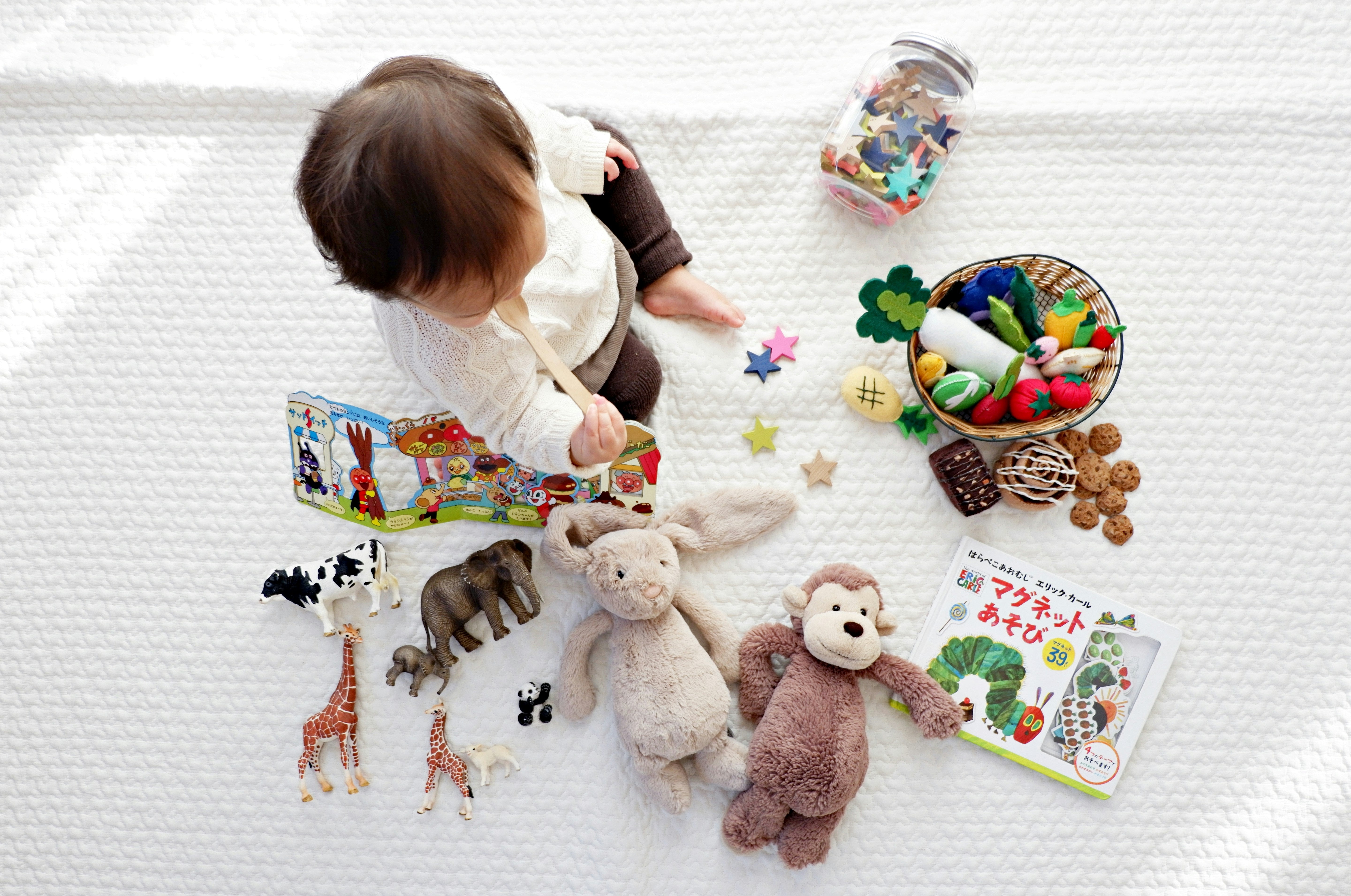
You probably already own one. Or you've stood in a shop holding one, wondering. There are a lot of them: cards that talk, pens that read, books that make sounds when you press the pictures. They promise vocabulary, pronunciation, a second language absorbed through play. They are not entirely wrong. They just don't tell you the whole story.
The honest answer is that language learning toys can help, but not in the way they tend to be marketed. Understanding what they actually do, versus what they appear to promise, changes how you use them. It also, usefully, takes some pressure off.
What toys can and can't do
A toy cannot teach a child to speak a language. That's not a criticism of any particular product. It's just how language acquisition works in toddlers.
Children at this age are not studying. They are not cataloguing. They are building associations between sounds and the world they are touching, tasting, carrying around, and handing to you. A word lands when it is spoken by a real person, in a real moment, connected to something the child can see or hold or want. Hearing a word from a device, even many times over, is not the same thing. The connection is thinner. It doesn't stick the same way.
This is sometimes called contingent interaction in developmental research: the back-and-forth that happens between a child and another person, where language is embedded in shared attention and response. Toys don't do contingent interaction. They do output. That's a meaningful difference.
What toys can do is increase exposure. For a second language especially, where a child may only hear a few hours a week from a minority-language parent, a toy that introduces and repeats familiar vocabulary in that language is doing something real. It is adding to the pool of heard language. It is making certain words feel familiar. It is keeping a language present in the room even when you are not actively speaking it yourself.
That is genuinely useful. It's just not the same as teaching.
The gap between recognition and production
One thing that confuses parents is that their child seems to absorb words from a toy without ever using them. They hear "banana" in French a hundred times and nothing seems to happen. Then one day it surfaces, in the right moment, as if from nowhere.
This is normal, and it matters for how you evaluate whether something is working.
Understanding comes well before speaking. A child can recognise a word, know roughly what it means, and file it away for months before it appears in their active vocabulary. If you are watching for spoken words as proof that a toy is doing its job, you will often conclude that it isn't, when in fact the work is happening quietly underneath.
The corollary is that the toy isn't failing when your child ignores it, or uses it as something to throw, or seems more interested in the box. Toddlers are not reliable indicators of what they are taking in.
What kind of toy actually helps
Not all language toys are equivalent, and the differences matter more than the marketing suggests.
A toy that runs on its own, cycling through content whether or not a child is paying attention, does very little. Background audio is background audio. A child who has learned to tune out a device will tune it out, and there's no mechanism to pull them back.
A toy that requires a child to do something, to make a choice, to take an action before language appears, is doing something fundamentally different. The child is not receiving language passively. They are seeking it. That small act of agency changes the quality of attention, and attention is where learning happens. Research on early language development is consistent on this: children acquire vocabulary faster when they are actively engaged rather than passively exposed.
This is also where native speaker voices matter more than parents often realise. A child who hears a word spoken by a real person, in the accent and rhythm of the language as it is actually spoken, is building phonological familiarity that no synthesised voice can replicate. This becomes especially important for minority languages, where a child may have limited access to speakers outside the home. A toy that brings another voice into the room, one that sounds like the language belongs somewhere real, does more than teach words. It builds a relationship with the language itself.
The most useful toys, then, are ones where the child is in charge. Where they decide what they hear, when they hear it, and how many times. Not because toddlers are reliable judges of what they need, but because the act of choosing sustains engagement, and sustained engagement is what repetition actually requires.
How to use them well
The difference between a toy that contributes something and one that just makes noise comes down to what happens around it.
A toy used alongside a parent, with words repeated, things pointed to, a shared activity made of it, does considerably more than the same toy used alone. The toy becomes a prompt for interaction rather than a substitute for it. If a toy introduces a word at home, and that word reappears at the table or in the bath or on the way to the park, it moves from something heard into something known. Repetition across different moments is how language consolidates.
For parents carrying a minority language largely on their own, this is where tools can carry real weight. The challenge is rarely motivation. It's hours. It's the fact that one parent may be the only consistent source of a language, and that parent cannot always be speaking, cannot always be on. A toy that holds some of that exposure, and does it in a native voice, extends what you can offer beyond what you can sustain alone. It doesn't replace you. It fills the space when you aren't there.
What you are actually asking
If you are wondering whether a language learning toy is enough on its own, the answer is no. Language develops through accumulation: many words, many contexts, many voices, across many ordinary moments. No single tool covers all of that.
If you are wondering whether it is worth having, the answer depends on the toy. A passive device that runs in the background is probably not doing much. A toy that a child can drive themselves, that returns to familiar vocabulary rather than endlessly introducing new words, that plays back language in voices that sound like the real thing, is doing something that meaningfully supports what you are already doing. Used well, it adds to the hours. It makes repetition feel like play. That's not nothing. For a lot of families, it's quite a lot.
This article is for general educational purposes and does not replace advice from a qualified professional. If you have concerns about your child's development, speak with a paediatrician or a speech and language therapist experienced in bilingual children.



Share: